Action games –well the great ones, anyway – are defined by three things: speed, precision, and player expression. A good action game might do one really well. The great ones have two of them. The all-timers nail all three. This is a preview, so I’m not ready to call Gundam: Rogue Orbit a great action game. But if what I played at Gamescom is any indication, it might just get there.
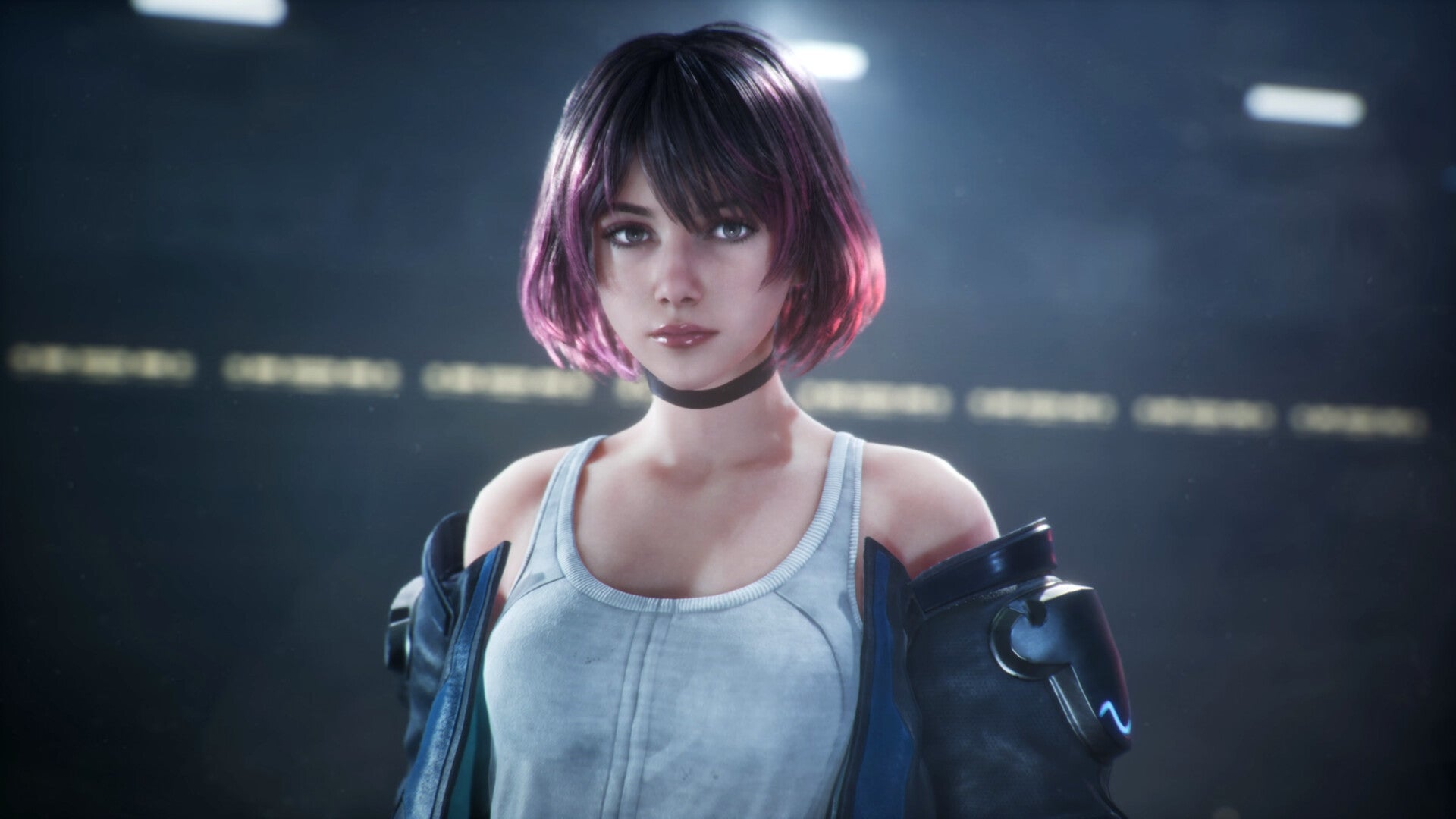
My Rogue Orbit demo was pretty simple: I would choose one of three pre-baked Gundam loadouts, and my pilot, RE-X, and his partner-in-crime VII would enter the cockpit. The scene starts with the camera behind RE-X and as he steps into the cockpit, it fuses with her perspective. The distance between the two of you evaporates. Those aren’t RE-X’s hands flexing as he settles into his pilot’s seat. They’re yours. It’s a small thing, but it’s one of the little details that made my time with Rogue Orbit work, and something producer Yuya Tomiyama and director Yoshiyuki Serizawa told me the team they spent a lot of time working on because players had said they wanted to feel that they were actually getting into the Gundam and going into battle.
Once snugly seated in my cockpit, I was off to my first mission. The Apocalypse – a group of scary, alien monsters – had invaded a spaceport, and it was up to me, my Gundam Helix, and my buddy Elaine and her Calice to take them down. After getting shot onto the spaceport by what looks like a giant railgun mounted to our ship (sick), it was time to layeth the smacketh down on some poor Apocalypse fools.
Rogue Orbit is quick; the loadout I selected was equipped with the Assault Sword, a close-ranged weapon with abilities designed to close the distance between you and Apocalypse beasties and dish out the hurt while you do it. Your Gundam is big and bulky, and there’s definite weight to it, but it’s also quicker than fast and you can easily use your boosters to slide around the levels as you cleave through Apocalypse monsters. I’d describe boosting as the kind of movement you’d see in an Armored Core game. You’re still on the ground unless you make an active effort not to be, but you’re cruising.
Clearing out the spaceport was pretty easy between my sword, special abilities, and rifle, and the level was pretty linear, but I didn’t mind. Where things really got interesting was the boss fight against a Giant, a massive member of the Apocalypse who has definitely never skipped his arm, chest and back workouts at the gym, but goes a little lighter on leg day. He was substantially bigger than my Gundam, but that just meant there was more of him to hit. I deployed my Slyphid AP-U – Apocalypse Unit, special weapons designed for fighting the Apocalypse – and watched as half a dozen little drones swarmed him with lasers. Helpful, but they wouldn’t win by themselves. I needed to take it to him, too.
It’s in these big fights that Rogue Orbit feels like it’s going to be at its best. I had to manage my heat, which you build from moving, dodging, attacking, and using abilities and make sure I wasn’t getting walloped. It’s pretty easy to mash in Rogue Orbit if you want to (just like any action game), but it’s not ideal, and you’re actively rewarded for being precise and picking the spots to use your abilities, which not only cost heat, but individual charges that recover gradually over time. I could have spammed the Assault Blade’s charged heavy attacks and abilities, but I would have overheated and wasted all my charges. Playing smart was key.
And I was rewarded for that, too. In addition to a health bar, bosses have a stagger meter that builds separately. When I filled it, the Giant fell to his knees and I got to whale on him. It was a perfect time to pop my abilities, land those heavy attacks, and use an AP Unit Burst, a devastating attack based on the AP Unit you have equipped. In the case of my little drones, they would swarm around the enemy like the biggest, angriest bees you’ve ever seen. Pretty rad.
But my favorite part of the fight was when I lopped the Giant’s arm off. See, you deal specific damage to body parts in Rogue Orbit, even if you can’t lock onto them directly. I didn’t know that at the time, but it turned out well for me because losing his arm also meant losing any attacks associated with it. I hadn’t just accomplished a cool visual feat. I’d functionally changed the fight. Tomiyama and Serizawa told me that was a core part of Rogue Orbit’s design.
“You can plan your strategy and also you can learn about the enemies; the way you want to attack, for example. Some enemies have weaknesses around wings or [arms]. So you can really customize yourself and you can learn about the target and you can plan your attack, as well. As you play, you sort of feel good about certain attacks. ‘I like using this one, I like to attack like this.’ So you start learning about it and you actually master your own skills.”
All of that came to a head in the demo’s second part: a fight against the Drake, a massive, dragon-like monster that could fly. This time, I went in with the whip sword, which could change form between a sword and a whip. It was kinda like playing Ivy from Soul Calibur, just as a robot. I adore it. Want to attack from range and look cool as hell doing it? You got it. Take out a whole gang of Apocalypse (Apocali?) at once. Done deal. And it’s a sword for the up-close-and-personal beatdowns? Be still my beating mecha heart. But the cool thing is the whip mode works great up close, too.
That was good, because the Drake was no joke. He could breathe fire, summons these little balls to shoot all kinds of lasers at me, and whack me with his tail. To fight him, I had to meet him in the air, which is where Rogue Orbit’s surprisingly spiffy vertical movement comes into play. You’re not quite as fast or agile in the air as you are on the ground, but I was more than capable of bringing the fight to him.
When I asked about it in our interview (and noted how rare truly 3D movement is in a game like this), Tomiyama and Serizawa said getting it right had been a priority: “That's what we really wanted to work hard on because we have to have the high speed and create movement. That really was a must. But the Gundam is fighting against big enemies. And also we want to create that scale of the Mobile Suits. It's big. So the Mobile Suit has to be [capable] and also the player has to feel good about controlling the Mobile Suit. So that feeling is something that we, again, we have to worry about [realizing] in the game.
“This 3D movement was really challenging to actually create, but we really wanted the players to feel good. They want to enjoy controlling the Gundam. And… in order to achieve that, we didn't want to make it complicated because people would give up on it… So in order to get action game functions ultimately, we had great research and it took us a long time to do lots of trials and also we asked the Bandai Namco team all over the world [for their] feedback. We are still making it, but I think we are on the right track in the right direction for that.”

They continued: “The mobile seat is 80 meters high and it's a mobile weapon in itself. So when we create an action game, we don't want this big thing to be slow obviously, but we want the players to feel the weight of it, the weight of the sword, the weight of the actual Mobile Suit. So in order to achieve the balance between the high speed and the mobile seats, again, we really have been working. There is also flexibility. There are functions that you can actually cancel when you're controlling the Mobile Seats. So everything is pretty much a balancing act.”
Based on what I played, I think they’re on the right track. The Drake was much tougher than the Giant, but it also gave me a chance to try out Over-Rise, which temporarily halts Boost Gauge consumption so you can go all out without overheating. It also makes it easier to execute Tactical Moves. Time one right, and you’ll slip out of an attack and right behind the enemy.

All of this feels great, but I also appreciated how much control I had over the fight. Now that I knew I could take out enemy body parts, Monster Hunter-style, I started targeting the Drake’s tail and its wings. Once they were gone, it couldn’t easily take to the air and I didn’t have to worry about its tail if I managed to dodge behind it. I even got to put the other AP-U – a deployable shield that provided cover from the Drake’s scarier attacks – to the test, and it worked wonderfully. I always felt like I had an answer to every issue, and it was a lot of fun figuring out which of my abilities did what, and when to use them.
I finished the Drake off early, so I opted to try it again with the Sword Lance. If the Assault Sword was a close-ranged monster and the Whip Sword emphasized versatility, the Sword Lance was a medium-ranged weapon that emphasized combining heavy attacks with dodge to build charges for a special attack that spawned exploding orbs of energy. I thought it would be right up my alley, but the slower speed and more mid-ranged, defensive style didn’t work for me. I smoked the Drake with the Whip Sword. With the Sword Lance, I had to rely on my healing items. I still got the job done. It was just much harder. But that doesn’t mean that I might not get on with it in the future. According to Tomiyama and Serizawa, I’d be able to customize weapons and the Helix itself to suit my playstyle in the final release.

When I exited the cockpit of the Helix for the last time, I felt good about what Rogue Orbit is shaping up to be, but I also know there’s a lot more to see, and the team is aware they have a lot to live up to. But I think, after speaking to Tomiyama and Serizawa, that’s part of the challenge – and the fun.
“This is [an open] door for new fans worldwide, but I'm aware that there are huge communities of Gundam in America, for example, and they are just so passionate and we haven't talked about it, but this has got all the aspects that make Gundam Gundam,” the producer and director told me. “So hopefully all the die-hard fans will appreciate that.”
📰 Original Source:IGN
✍️ Author: Ryan McCaffrey
Leave a Reply