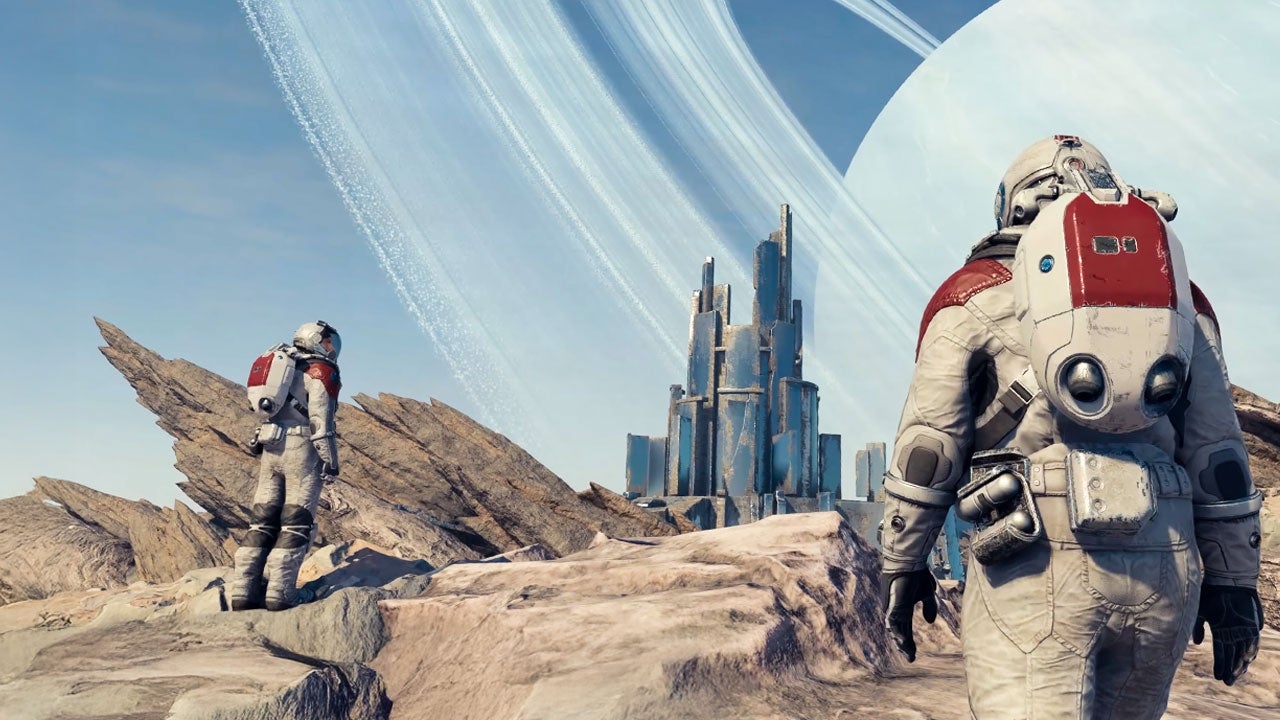
Whatever you do, don’t call it Starfield 2.0: At a recent preview event for the big updates and content drops coming to Starfield, Bethesda seemed eager to downplay any comparison to the kinds of extensive overhauls enjoyed by the likes of Cyberpunk 2077, No Man’s Sky, or indeed, Fallout 76.
Personally, I think they’re selling themselves short: while the Free Lanes update isn’t a big ground-up remake of Starfield that magically transforms it into a different game, none of the other things we might be tempted to compare it to are that either. No Man’s Sky and Cyberpunk 2077 are still, away from all the hype, largely the same minute-to-minute experiences that they were at launch. Whatever they clamp onto it, Starfield is and will remain Starfield – a space life sim and questing RPG that offers a scifi twist on the basic core gameplay that Bethesda have been peddling since Morrowind. The same framework, the same idiosyncrasies, and more or less the same engine. The latter being the big, underlying Starfield problem you cannot fix by throwing more stuff into it.
Overhaul or not, what’s coming on April 7th is a suite of crowd-pleasers: a bunch of free DLC, a not-free expansion, the much rumoured PS5 version, and an extension to the ever popular best-in-class ship builder. The Free Lanes update is the key thing: it vastly expands the space sim part of Starfield’s burgeoning package to include Cruise Mode, which essentially adds a new layer of game sandwiched between the on-planet and in-orbit stuff that’s already there.
Cruise Mode allows for manual travel between planets, something which was always technically possible, but pointless, arduous, and infamously broken. Now it’s a cool, fast way of getting around star systems that comes with its own unique challenges and radiant events. Free Lanes also adds a new major space port, Anchorpoint, sure to be a wretched hive of scum and low-tier freelance opportunities, like the average Games Journo discord.
Fans of Fallout’s vault boy bobbleheads (that’s all of us, right?) will enjoy the new Colony Wars action figures and associated playsets: a set of interactive toys that give stat boosts. This adorable addition feels like a concession to the idea that Starfield always felt a bit more po-faced than the other Bethesda games. It’s certainly the least intentionally goofy, and not in a good way.
Bringing back this beloved Fallout feature in this enhanced in-universe toy form brings a sense of sorely missed daftness, but also meaningfully connects Starfield to its much more beloved stablemates: a reminder of why Skyrim in Space was such a compelling pitch in the first place. For better or worse, Starfield is every bit a Bethesda game, and we used to love those warts n’ all.
So, while Free Lanes isn’t a ground-up redesign, it’s a pretty generous update for an almost 3-year old single player game that is considered something of a critical flop, a game that feels destined to fade in memory as Bethesda turns its limited attention back to its flagship series (although it must be said that Starfield was not, as is commonly believed, a commercial failure). But chucking more Stuff into Starfield emphatically fails to address the game’s most critical underlying issue: not a lack of stuff, but how it is organised across vast tracks of nothing.
Long-serving Bethesda producer Tim Lamb started the recent presser with an awkward, half-joking acknowledgement of the fact that Starfield is seen as, in his words, “irresponsibly big”. A game with a Skyrim’s amount of stuff spread thinly across hundreds of planets. Whereas most Bethesda adventures are stuffed precariously into a tiny continent like a suitcase full of octopuses, Starfield ekes its hand-crafted quests out like a disorganised dad scratching molecule-thin layers of the last of the margarine over some toast with a toothpick.
One might argue, as I have, that Starfield could have done with being a lot smaller. But you can’t make it smaller in updates: it’s already here, in all of its empty vastness. And so the only way forward is to put more stuff in, while neatly addressing the other big criticism of Starfield: that it’s a space sim which doesn’t bother to simulate space. Free Lanes certainly goes some way to addressing that, and I can’t wait to start a fresh game on PS5 Pro when the new version drops next month. But expectations must rightly be tempered, because this is a game operating right on the outer limits of what is possible with Bethesda’s tech.
The Creation Engine gets a lot of flak for always being a generation behind. You hear it constantly: “why don’t Bethesda change to a new engine?”, “why are they still using Gamebryo?”, “they own id Tech 8, why can’t they use that?”. Well, there’s a reason why Bethesda’s games are so distinctive: their tech is a cell based system that treats every space as a separate room, compartmentalising the entire game world into a hierarchy similar to a directory tree. You’ve got a vast overworld which is like your root directory, from there you can enter cities, then individual buildings. Every time you transition into a new room or cell, the game flushes your current environment out of memory and loads in a new one.
That’s why Bethesda’s games are characterised by the dreaded loading screens: it’s not an engine designed for the kind of seamless world streaming that allows for something like Crimson Desert, or Red Dead 2, where assets are loaded in and flushed out dynamically depending on where you are and where you’re looking. It’s why NPCs in Bethesda games fade to nothing when they go outside, instead of opening the front door and stepping through.
The advantage for Bethesda to stick with their tech when there are seemingly better alternatives is that it allows them to build huge worlds and fill them with intricately scripted quests, fully simulated towns and cities, and barrel-loads of interactive parsnips, very quickly and easily. And over the years they’ve gotten very good at streamlining the process: lots of incidental details and world interactions are automated. If an NPC’s patrol route takes them near a source of heat, they’ll stop and warm their hands. That’s a baked-in behaviour that’s triggered by context, which the quest designer doesn’t have to worry about. There’s also the advantage of being able to track thousands, even millions of fully simulated physics objects across the entire game which is much more difficult to do in streaming based engines, which is why in The Elder Scrolls you can leave a pie on the floor somewhere and it’ll very likely stay there until the end of time while GTA has cars and pedestrians that disappear forever if you happen to look away.
To be clear, this is a layman’s understanding: I’m not a game dev. And I’m certainly not saying there’s a right way or wrong way to make an open world game. Every different way of achieving something has pros and cons. Creation 3 would suck for building GTA and Rockstar’s RAGE engine would be horrendous for building an Elder Scrolls game.
There is an argument that perhaps Bethesda should ditch all the granular physics stuff that allows them to build all those lived in spaces full of interactive world clutter, and maybe reduce the scope of their games a bit so they could put out more games in a newer engine. Luckily, we have a case study for that: Obsidian’s Avowed is the closest thing we have to an Elder Scrolls game built in a modern engine, in this case Unreal 5. And everyone thought it sucked, in part because it wasn’t as interactive as Oblivion was twenty years earlier. There are things intrinsic to a Bethesda game that you just can’t remove.
But there are obviously hard limits to what you can do with a system designed to organise a vast world into tiny, distinct chunks, and it’s clear that Starfield is a massive square peg of an idea trying to fit into the round hole of Bethesda’s technical capabilities. You can practically see the bones of Morrowind creaking to accommodate its ambition, where entire planetary surfaces are separated into a vast grid of square cells. This is obviously a massive oversimplification, but essentially, a planet in Starfield is like an Oblivion mansion with millions of doors.
Cruise Mode looks like it’s more or less a giant “room” where you fly around a diorama of the solar system. Interdictions that take you back into Normal Space do so with a very obvious bokeh-dissolve that really doesn’t hide the join all that well. Making a space game with Bethesda’s tech is like building anything more substantial than a personal blog in WordPress: possible, with caveats. Cramming a space sim into a framework designed very specifically to make Elder Scrolls games was always going to be something of a bodge job. They’re doing the game design equivalent of building a car with nothing but garden tools, the fact that it gets anywhere at all is quite remarkable.
Though it’s Bethesda’s most forward thinking game in spirit, in practice it’s a massive regression, a throwback to the procedurally generated vastness of Daggerfall, a game so big it felt tiny: boasting a land mass twice the size of actual Great Britain but with nowhere near enough intrigue to fill a shed in Swindon, it could also have been described as irresponsibly big.
Its sequel, Morrowind, the game that put Bethesda on the map and provides the basic template for their games to this day, made a point of being entirely hand-crafted. Not even a single percentage point of the size of Daggerfall, it nonetheless felt enormous, because its map could barely contain all of the intricate adventures within. Back then, Bethesda learnt the lesson that less is more, but it seems to be a lesson it is eager to forget.
Starfield isn’t anyone’s favourite Bethesda game. It certainly isn’t mine (Morrowind, need you ask). But I admire it for how close it gets to an ideal that should be entirely out of the question. If nothing else, it’s a masterclass in making do. Free Lanes isn’t a do-over, or an overhaul, or even something that makes Starfield palatable for those who bounced off it before. But it does add a rich new set of features and intrigue to a game that many of us desperately want to love, because for all of its shortcomings, it is Skyrim in Space, and even after we’ve been presented with a gigantic neon sign that says “Skyrim in Space Doesn’t Work”, it remains a most enticing prospect.
Jim Trinca is a Video Producer at IGN, and when he isn't fawning over Assassin's Creed, he can be found watching Star Trek and eating stuff. Follow him on @jimtrinca.bsky.social
📰 Original Source:IGN
✍️ Author: Jim Trinca