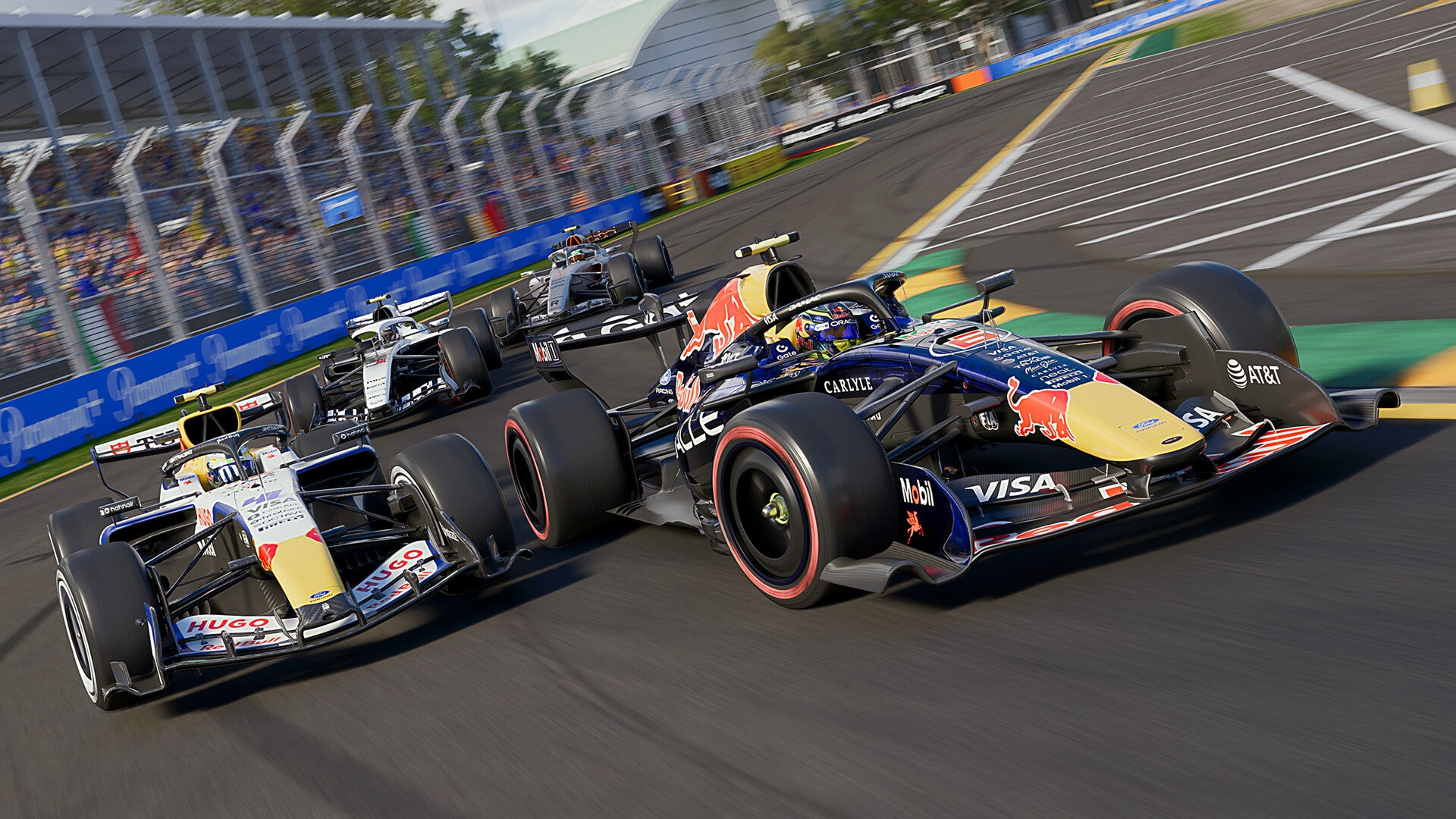
Since it acquired the F1 license in 2009, UK-based studio Codemasters has walked a precarious sim-cade tightrope with its F1 games. It’s never been as rigorous in its physics simulation as iRacing, rFactor or Assetto Corsa Competizione, but neither has it shied away from capturing the details and demands of the sport and packaging them up into an entertaining and ultimately rewarding race weekend.
But replicating those details will introduce a difficult new element when it comes to the next F1 game. Machine learning AI supercomputers are taking control away from Formula One drivers. Borne of the new 2026 season regulation changes, it’s a phenomenon that’s usually subtle because it works by controlling the power deployment of extremely complex hybrid power units. That’s quite tricky to eyeball from the onboard broadcast cameras. But when that AI-controlled power deployment goes wrong, it makes itself extremely conspicuous.
At a drenched Sepang circuit on the first weekend of October, race fans were treated to the sight of 22 vehicles representing the pinnacle of motorsport losing throttle and trundling at 20mph on the warmup lap. It was the result of a software glitch triggered by the wet weather and the way Sepang’s sectors are configured, and it required all teams to install a software update to their cars before the race could begin.
Lewis Hamilton, whose Ferrari came to a complete standstill on the start-finish straight, later reported that he had to do a full engine restart, essentially CTRL+ALT+DEL’ing his vehicle on the track in order to gain back some throttle control and power deployment.

One race earlier at Baku, Valtteri Bottas retired in the later stages of the race after suffering a very unusual accident. It looked as though the veteran Finn had completely missed his brake marker going into turn 15, locking up and crashing into the barriers. Only afterwards did Bottas reveal that the crash wasn’t down to driver error, but the energy deployment system.
“It was quite strange,” he told GPBlog. “On the same lap I went off in turn one, I went wide. Then I think the system’s got a bit confused. I had a huge super-clip, and then when I hit the brakes only the front brakes would work, almost like I wasn’t harvesting anymore with the rears.”
Super-clipping is another bit of autonomous driving whereby the power unit reduces throttle in order to harvest energy for the electric motor. It’s a bizarre sight and sound – a Formula One car coasting into a corner way before the braking zone, as though it’s running out of fuel.
What these incidents reveal is just how much of the 2026 F1 car is out of its driver’s control. And oddly enough it isn’t so much these obvious moments of malfunction that are the problem, it’s when things are operating as planned. That scenario’s just as damaging to the sport.
After pulling off an overtake on seven-time world champion Lewis Hamilton in Suzuka earlier in the season, Lando Norris later told the official McLaren website “the battery deployment triggered, even though I didn’t really want it to, and I had to overtake Lewis as a result.
“That meant I was then a sitting duck on the next straight, where I had actually wanted to use the battery… For me, that’s taking too much control away from the driver.”
The fact that Norris could accidentally overtake 106-time race winner Lewis Hamilton, and himself feel hopeless to defend his position moments later, tells you all you need to know about how powerful the electric energy deployment is in the 2026 F1 cars, which feature about a 50:50 ratio of turbo engine and electric motor power.
It also explains why many have criticised the racing as so unnatural to watch: the power difference between a car deploying that electric power in ‘boost’ mode and a car without boost is enormous, so much so that it looks like cars from different categories racing on the same track. Or, as Charles Leclerc put it earlier this season, “This is like the mushroom in Mario Kart.”
So you’ve got drivers openly criticising the current regulations, power units glitching out and requiring software updates before the race can go ahead, and people accidentally overtaking each other.
Now imagine you’re a developer at Codemasters watching this unfold. What do you do?
Codemasters has always put emphasis on the sport’s very specific details. Over the years, that’s meant you’ve always had to pay attention to tire wear and engine map modes, for example. In the recent games’ driver career mode, your power units become worn and using more than the allocated number over the course of a season incurs a grid penalty. You participate in Friday practice sessions to build up currency that can be used to research and manufacture new engine and aero parts.
When DRS was introduced in 2011, Codemasters also introduced it to F1 2011. Likewise ERS battery management in 2014. It’s always taken pride in simulating the minutiae of the sport, as it appears on TV screens that season, even if the simulation itself isn’t as mathematically forensic as a hardcore racing sim.
The 2026 season DLC goes some way towards capturing the current regulations. Battery deployment is an important part of racing, and there’s some nuance to how and when you harvest battery, depending on whether you’re in a straight zone, and whether your throttle is pinned above 90%. Crucially though, the game keeps you largely in control of battery harvesting and deployment unless you enable a driving aid to let the game handle it. That’s very different to the AI auto-deployment situation with its multitudinous bugs we’re seeing on the real track.
So how should F1 27 capture this energy deployment situation? It’s hard to imagine how this auto-deployment of electric power will add to your sense of satisfaction in either solo or online play, let alone how the differences between teams and their AI supercomputers might affect race outcomes. This puts the next F1 game in a fascinating position. The better a job it does of simulating Formula One, the more it will feel buggy and broken. If F1 27 goes for maximum realism, cars will slow down on straights when you’re got the throttle pinned. You’ll experience random surges in your car’s pace, and then be left feeling like you’re in a GP3 car a couple of corners later. Maybe your team-mate will trounce you because their AI deployment’s simply working better than yours.
Fans have always wanted F1 games to offer racing that’s as close to the real thing as possible until now. F1 27 might be the first time they’re genuinely ok with a developer using some creative licensing.
Best case scenario, the International Automobile Federation (FIA) bails Codemasters out from having to make that call. Planned regulation changes for the 2027 season will allow the cars’ electric power harvesting to pick up more battery during braking zones, while deploying less on straights. So the boost button should feel less like a Mario Kart mushroom, and we should see less super-clipping on straights. Should.
If the hastily compiled regulation changes work as the FIA intends, the racing in both the real sport and the 2027 game becomes a lot more orthodox. But the FIA doesn’t really know if it will work – nobody does. The fact it’s increased testing time before the season is tacit admission of that fact.
And because the season starts in March, Codemasters is going to have to react extremely quickly to the effects of those 2027 regulations. The developers are used to working fast when it comes to dialling in team and driver performance, usually having just a few race weekends to work from before the game releases. But this is more fundamental. This deployment issue dictates everything from race strategy to the basic inputs needed to control the car. Essentially, F1 27 won’t be able to commit to its handling model until Codemasters has seen the 2027 cars in action.
Of particular interest will be the online racing, which is a hinterland of bitterness and spite at the best of times, let alone when accusations of cheesing the energy deployment might carry weight. The fastest drivers in the F1 series find the meta extremely fast, and if there are exploits to be found anywhere in the setup, or in the quirks of the handling model, they’ll exploit them like a multinational corporation exploits tax loopholes. No pressure, then: just adapt to the 2027 regs, make the handling and deployment watertight for the elite players, while remaining understandable and enjoyable for the casuals. By tomorrow please, thanks.
One mode, at least, might offer something of a get out of jail card for the next release. Since F1 25, My Team mode has given you the chance to vote on proposed regulation changes at the end of each season. Usually this modifies R&D rules or cost cap, creating some exciting ‘reset’ moments for teams hoping to catch up on the development race.
But what if you were able to vote on an AI battery deployment ban? For racers looking to return to a more familiar and manual way of driving, that might be F1 2027’s best gambit. At least, until the FIA sorts the real sport out.
📰 Original Source:IGN
✍️ Author: Matt Purslow
Leave a Reply