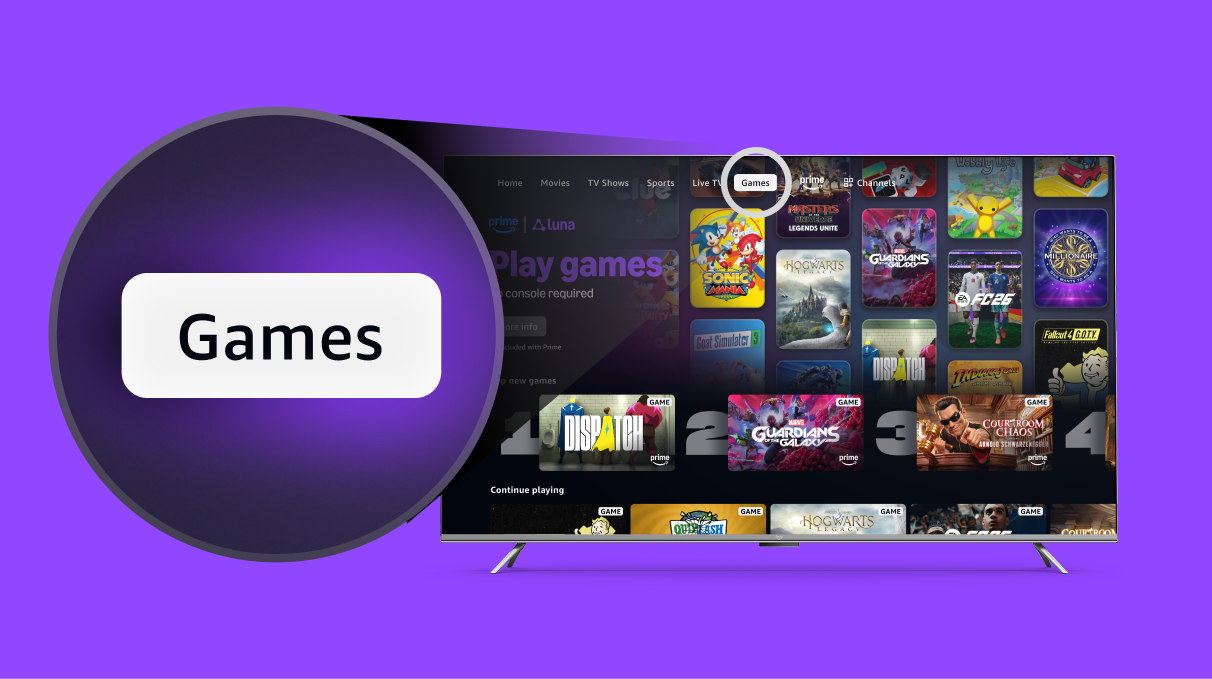
Amazon has announced that its cloud gaming platform, Luna, is now available on Prime Video — as long as you’re in the U.S. or UK and are using the streaming service on a Fire TV.
The rollout is part of a wider push from the corporation to get the games that Luna offers into as many hands as possible. Luna is included with Prime at no additional cost, and there’s nothing to download or purchase to start playing.
Amazon said Prime members can find games the same way they discover everything else on Prime Video, just by looking for the new “Games” tab and starting playing in seconds on your TV, using a controller or your phone. On Luna, Prime members get access to a library of games that includes Hogwarts Legacy, EA Sports FC 26, and Indiana Jones and the Great Circle, as well as party games like Clue, Ticket to Ride, and Taboo. Amazon said it plans to add new games ever month.
"For a lot of people, games have been harder to find than they should be,” said Jeff Gattis, GM of Gaming at Amazon. “Bringing Luna inside Prime Video allows Prime members to discover games more naturally, and if they see one they like, they click it, and they’re in. That’s less time searching and more time playing great games included with their Prime membership.”
More details on “additional devices, countries, and games in the months ahead” will be revealed in the future.
IGN spoke to Gattis about this new approach for Luna, cloud gaming in general, and in particular, why both have struggled to gain a widespread audience over the years. Amazon with Luna, Google with Stadia, and Microsoft with Xbox Cloud Gaming have all tried and failed to achieve breakout success.
“I was at Xbox when we were pushing out X Cloud,” Gattis said. “I think part of the problem is cloud gaming was sort of positioned at core gamers as you don't need a console. There were marketing campaigns around no console required. And in many ways I think that the core gamer who's invested in a console, who's invested in a $3,000 graphics card, not only is committed to that hardware, they love that hardware. They love that fidelity.
"So I think part of it was a product market fit problem where we were marketing clouds, and I mean collectively as an industry, at the wrong people, whereas I think there is a much broader audience that will probably never own a console or never own a game PC and never get a chance to play a lot of these games. That's where I believe in the cloud.”
Not only does Gattis now think that the right audience is being catered to with cloud gaming, but that the tech has caught up with the ambitions of the platforms. “The technology's only getting better,” he insisted. “Several years ago, you would notice latency in certain people’s connections, and you just weren't getting the fidelity that you needed. A lot of that has been removed. So now it's almost like you have to rebuild trust in people who had a bad cloud experience five years ago.”
In terms of Luna, specifically, Gattis believes its current level of popularity is down to how it was positioned when it first arrived on the scene. “I'd say Luna in some ways was trying to compete at the high end of the market with the notion that cloud gaming is just magically going to happen,” he said.
“And when it does, everybody's going to come to Luna and start turning in their consoles and their PCs,” he continued. “That hasn't happened yet. I'd argue if that does happen, they're not automatically going to jump ship from Xbox and PlayStation's team.
“That market is extremely well served. One might even argue it's overserved today where they're all just competing for the same customers, same players; the pie's not really growing. Let's not compete. They can have that at least for now. But what we saw was a broader opportunity where Amazon, we think, can add real value. 3 billion people in the world play games; only about 500 million own consoles and PCs. So we have a lot of people out there that actually like to play video games, but aren't playing in the highest fidelity setting, aren't playing in a living room on a big TV or on a PC monitor.
"We've taken all these games that were previously in a premium subscription with Luna, and we've taken most of them and pushed them all into our standard tier of Luna, which effectively is a Prime benefit. So there's literally close to 100 games in Prime right now that if we're one of the 100 million Prime members worldwide, we have access to all of this. So part of our big challenge is, how do we actually let people know they have this benefit?”
Gattis explained how Luna’s integration into Prime Video will, in theory, aid discoverability: “You launch Prime Video to watch your favorite show, there'll be a games tab right on the top, and that's all the Luna content that you're entitled to be there for you. And so that's a first step in terms of just driving more awareness, and hundreds of millions of people use that app and watch video there."
“And so you can imagine this future where you're going to go to a page, say in Prime Video, and instead of it just being a bunch of things you can click on and play, it's almost a fandom type page," he continued. "If you're a fan of Tomb Raider, here's the show, here's the TV show, here's the game, here's past games, here's a Twitch feed, here's merchandise you can go buy on Amazon.com. So I think that's the vision for us where you start to bring all these things together and think more of general entertainment as opposed to video games being this entirely separate thing from other views.”
This synergy between Amazon’s video game, movie, and TV show output is something Gattis clearly sees as a big part of turning Luna into a success story.
“I fundamentally believe you're seeing a continued intersection between TV video and video games, interactive entertainment,” he said. “So I really think of the future, you'll see every TV or movie is going to have a video game story attached to it, whether that's a AAA game or just some sort of extension of the experience. I think it's going to be just part of how films and TV IPs go to market. And so for us, we want to take advantage of that. So you'll see us invest a lot more in making things alongside MGM properties or other Prime Video shows. Obviously Tomb Raider is coming out next year, there will be a Tomb Raider TV show on Prime Video.”
Amazon highlighted the Masters of the Universe film, which is now streaming on Prime Video, and how you can now play co-op card battler Masters of the Universe: Legends Unite all from the same subscription. "See the movie, then play in its world, same screen, same night, same membership," Amazon said.
Another example, per Amazon, is its AI party game, Courtroom Chaos: Starring Arnold Schwarzenegger, where you argue absurd cases in front of Arnold as the judge. Later this year Schwarzenegger will appear in Prime Video holiday movie, The Man with the Bag. "Watch him one night, play against him the next," Amazon said.
Only time will tell if Amazon’s new approach to Luna will buck the cloud gaming trend and build a big enough player base to be considered a true success. Getting it in front of many more eyes is a logical first step, of course, so let’s see if Prime Video holds the key to unlocking the platform for millions.
Simon Cardy is a Senior Editor at IGN who can mainly be found skulking around open world games, indulging in Korean cinema, or despairing at the state of Tottenham Hotspur and the New York Jets. Follow him on Bluesky at @cardy.bsky.social.
📰 Original Source:IGN
✍️ Author: Wesley Yin-Poole
Leave a Reply