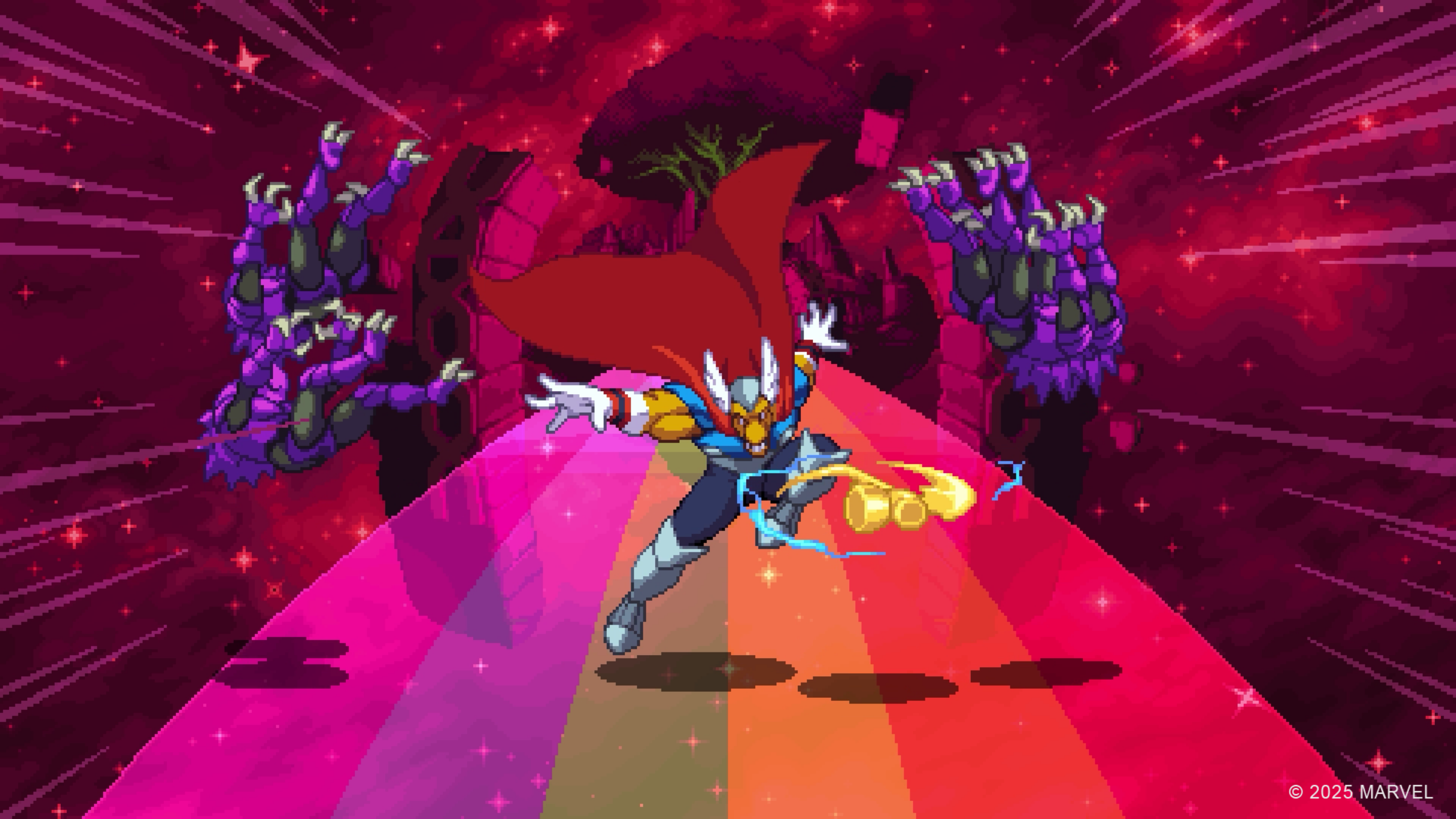
Marvel Cosmic Invasion is a hit. With 1.5 million players, Tribute Games' ‘90s-inspired beat 'em up follows in the successful footsteps of its similarly nostalgia-fueled Teenage Mutant Ninja Turtles: Shredder's Revenge. Both games are popular pick-up and plays in my household, where my eight-year-old son and I often grab a couple Xbox controllers and boot up the Xbox Series S for a quick session or two. Local co-op is great fun — I get a blast from the past as someone old enough to have grown up playing beat 'em ups in the arcade with friends, and my son gets to experience something similar with me at home. And when it comes to Marvel Cosmic Invasion itself, he has plenty of questions. For example, what is a Beta Ray Bill, and why does he have Thor’s axe?
Marvel Cosmic Invasion is no fluke on Marvel’s part, either. As Marvel Games executive producer Eric Monacelli, and product development manager Brian Marquez tell me in a video interview, the team set out to make a game that would appeal to people just like me. They told me they’d hoped that parents would play Marvel Cosmic Invasion with their children, sparking that cross-generational video game magic. And beat 'em ups are the perfect choice to facilitate it. That, and the '90s are so in right now. I’m going to enjoy the '90s being in vogue for as long as it lasts!
Read on to get some insight into the development of Marvel Cosmic Invasion, what Marvel Games looks for when it comes to video game characters, and why there's plenty more beat 'em up action to come.
IGN: I’ve had a huge amount of fun playing Marvel Cosmic Invasion with my son. Is that what you’re seeing as a typical experience of people playing this game, where for parents it’s nostalgia but they can play with their kids because it has local co-op?
Eric Monacelli: Yeah. That's the goal we set out to, right? We want to preserve some of that history and some of that zeitgeist. I grew up with a lot of the old Marvel beat ‘em ups that were in Marvel MaXimum Collection and played those. But that sort of cross-generational appeal, appealing to the nostalgia and the retro feel, and then getting parents to be able to play that with their kids, and then you can debate about, who likes their version of the game better? Is the old Spider-Man beat ‘em up up better than the new one? I love that sort of conversation happening and making games that really linger and last and create generational debates and conversations, and just stir up a whole new set of opportunities for the younger generation to become Marvel fans, and also for the older generations to revitalize their love of Marvel or have a new fresh take on it from a different perspective. That's what we've been striving for and that's awesome to hear that you're playing with your kids.
IGN: My son has lots of questions about the various characters that are in it. He knows the big ticket Marvel characters, the ones that have been in the MCU, for example. But you've got some obscure ones in there. He didn’t know Beta Ray Bill for example. How do you decide on the lineup? How does Beta Ray Bill happen rather than Thor?
Brian Marquez: We wanted to have characters that people recognized and that people were familiar with because we wanted people to grasp onto somebody that they immediately could resonate with. But we also wanted to have characters that were fresh and new, that people could become new fans of, or to ask questions about like your son had. But when it came to choosing somebody like Beta Ray Bill over Thor, we really wanted to work with our dev collaborators to come up with characters that had unique movesets. So with Beta Ray Bill specifically to your question, we wanted to have somebody with a different weapon. Yeah, Thor had the Mjolnir, but Beta Ray Bill had the Stormbreaker. So how could we make the Stormbreaker different and more appealing and more interesting in that gameplay comparatively to a Thor, and how can he be different and more bombastic in this title?
Eric Monacelli: And from a high level too, just like you said, your son was interested about Beta Ray Bill and we want that conversation. You probably had to explain who Beta Ray Bill was to him, I assume, right?
IGN: Absolutely!
Eric Monacelli: So that's exactly what we're going for. If you're a casual fan and you just know Thor is Thor, or you're a hardcore Marvel fan and you know who Beta Ray Bill is, we want those conversations to happen between generations, and having those educational moments. That was a very important thing, and I think it’s great for not only our IP, but just for story continuity and really good storytelling and continuing these characters' legacies.
IGN: It’s a beat ‘em up. Is there something about beat ‘em ups that really lend themselves to what you're trying to do here? Is that the perfect genre for the nostalgia play, but also to try and get that cross-generational play together, as opposed to say more traditional AAA action games that might have more to them but might be more complex, or even fighting games, which might be more complex still?
Brian Marquez: What's great about beat ‘em up games is that they're so easy to pick up and play. They are difficult, yes, but they're just easy to pick up a controller and just hop on in either by yourself or with a group of people. And as we've all experienced here with the older generation of games, the ones that we see in the MaXimum Collection or with Marvel Cosmic Invasion — Eric mentioned that he grew up with some of the games. I still have my childhood cartridge of Spider-Man and Venom: Maximum Carnage, literally in the other room — those games are super great because you can literally just turn it on and hop into the game with very little barrier to entry. And with these, we really wanted to have that same experience for people. You just turn on the game, you jump in, and you're immediately in the fun. And Tribute, the developers for this one, and Dotemu, the publishers, they lived and they developed by this philosophy of the games being as enjoyable and exactly as you remember growing up.
So they may not play exactly as they were because obviously they were very hard. They were very, for lack of a better word, clunky back in the day. But they play as you feel you remember them. They're still very easy to pick up. They're still very fun. They're still very enjoyable in that sense. And we wanted people to have that same feeling there with the nostalgia, you jump in, you immediately get that sense there with your friends, with your family. So yeah, we really wanted people to have that same enjoyment.
Eric Monacelli: We make live service games, we make hardcore AAA console games for the people that have gamed a lot longer and have higher skill threshold, or fighting games, that sort of thing. And so we just have a wide diversity of different genres and things we do with our IP. We just want to have something for everyone. The thing that I always try and emphasize is we're trying to make our games as accessible but advance them beyond where they are, past memories of genre or something like that. So whenever we approach and work with different dev teams and collaborating, we're like, "All right, cool. What can you do to take this genre and make it cooler? What can you do with these characters to just amp it up and really, really advance it a little bit and put your own unique touch on it?” That's part of the reason we go into it.
IGN: You recently released the first DLC characters, The Thing and Cyclops, for Marvel Cosmic Invasion. Of course, these two characters are about to be in a new movie, and Cyclops is in X-Men ‘97 Season 2 also. From a video game perspective, do you try to line things up so DLC characters capitalize on other things that are going on at Marvel, like movies and TV shows? Because that felt deliberate to me.
Eric Monacelli: We always wanted to tap into the zeitgeist and what's happening, and we work across Marvel to figure out what's going on. Does that always work? No! But we try our best, right? Lining things up, especially with these kind of games — and that's kind of the cool thing with these beat ‘em up games is it gives you the flexibility given the dev time and the cycles you need to do with these, compared to some of the other games that take a little longer to work on. And don't get me wrong, these games do take a lot of blood, sweat, and tears and hard work to get where they are, but it's a little bit shorter. And so you can align things a little bit more precisely.
Brian Marquez: Yeah, absolutely. We do our best to try to line things up with what might work in the overall Marvel zeitgeist. But also going back to our earlier conversation, we look at the characters that we have and we look at who can vary up the gameplay the best, what can make for a unique character in the roster, who can make for the most different unique move set. And also, with the game being out, what do people want? What's cool? Not that we're looking at everybody and seeing what everybody is screaming for, but like, what do people want for these types of games? And obviously Cyclops is a very popular character and he lines up with everything and he makes for a unique moveset in this title. So the stars really lined up for this one. And The Thing also was somebody that was very, very cool. He's very huge, he's very weighty, he's very strong. They were both just kind of no-brainers for this.
IGN: Marvel Cosmic Invasion, beat ‘em ups, X-Men ‘97… the '90s are hot right now. Does that help games like this be successful? Is there something special that's happening right now that you're seeing on the Marvel side that suggests the '90s is the perfect decade for everyone to be trading off of now?
Eric Monacelli: Yeah. I think that cultural attention and perception kind of moves in 20, 30 year cycles, right? So when you get to a certain threshold, like the '90s, the early 2000s are cool right now, and then let's say 10 years from now it's going to be later 2000s, 2010, right? And so it's going to trend like that and that's just something I feel like historically Marvel's done phenomenally well throughout its history. It's just had a real adept cultural fluidity where they pay attention to what's popping in the zeitgeist and tap into it.
Especially the people we collaborate with, I think it just comes down to what they grew up with, what they wanted to work on, that sort of thing, what they feel is good or what influenced them sometimes. And a lot of that you'll see that pop up in that 20, 30 year window. I think it's just fortuitous. I don't think we consciously plan that way, but it just kind of happens.
IGN: Is there a Marvel loremaster type person who works with the developers to say, for example, 'No that costumes shouldn't be like that,' or, 'No, that person wouldn't say that.' Or, 'Actually there was a comic 30 years ago that no one read that established this.' How do you go about making sure everything's authentic? Is there this one person who's just the most genius Marvel historian that you draw upon to work with the studios in that way?
Eric Monacelli: Everybody goes into Marvel at a different time in their life, right? Some people know the '90s stuff, some know the 2000s, some know the '60s, '70s, '80s, wherever it is. And so I think it's hard because there's so many stories being told and there's so many there. But yeah, we have definitely some folks on our team that we work with. Our creative team is amazing. They're all different ages and they all have their own take on what Marvel is. And so sometimes we get influences from all these different people. We'll fact check, we'll go back, we'll talk to other people, we talk amongst the company, hear what's to be said.
And yeah, there are some people that have just been at Marvel forever that just know everything, right? And you will go to those people occasionally to ask, "Is this right? Do you remember this?" And sometimes they'll just pull that out of some comic issue you don't even remember. And we love working with publishing and all our different teams for this sort of thing. But I would say that it's a collective effort. We value creative collaboration over everything and that's kind of how we work. But we definitely have some folks that do focus in and know their lore a lot, but we hire very well to make sure that our creative team can assist our dev teams.
IGN: My son’s Marvel reference point are the MCU actors. He sees Captain America as Chris Evans, Iron Man as Robert Downey Jr, and Thor as Chris Hemsworth, for example, and he closely associates those characters with their likeness. But from a video game perspective that's not necessarily going to be possible to replicate. I remember the Marvel's Avengers game, there was a whole thing about that. Is it an issue where you want to have the generation that knows Marvel best from these actors so it's recognizable, but you can’t? Or have you not encountered any issues with having to deal with that in the game space before?
Eric Monacelli: Everybody taps into Marvel at a different point. For instance, for me, Hawkeye Clint Barton was when Matt Fraction and David Aja drew him in the early to late 2010s, right? I still picture that when I think of Hawkeye and Clint Barton, and that's my Hawkeye more than any other version of Hawkeye in the world because I just love that and connect with that character so much. That's what we try to do with our games, is that we want to give the development teams and the collaborators that we work with enough creative leeway to put their own stamp on it, their own spin on it, and express it in their own world. These are all different stories and set in their own game worlds that we're telling.
Of course, yeah, we'll look at the movies, we'll look at the films, we'll look at the comics and pull reference from there. But we don't expect anybody to completely just be like, "Oh, we're going to hire that actor because people know them,” unless they really, really have a good case for it or want to. We're open to it, but honestly, it's not really come up too much, because our dev teams tend to just want to put their own stamp on it, be part of the Marvel legacy of storytelling, and we love that.
IGN: I guess I'm surprised that it's not really come up because to me, having an Avengers game with the actual actors reprising their roles or likenesses would probably be an incredible thing to see. But if it’s just not been a thing that anyone's wanted to do, fair enough.
Eric Monacelli: Well, we've talked about it, but it just doesn't go past… And the production reality with a lot of the bigger games too, is just like, imagine having to pay all that cast and develop the game, right? It's just dollars and cents sometimes. I think that's probably why it hasn't come up too much. But there have been conversations on other games in the past, and we've had some pretty big name actors in our games as well.
But generally it's like, all right, what voice actor or performance capture actor/voice actor will best embody the values and ideals of this character? That's what everybody looks for. So you got your Brian Bloom playing Captain America, but you also had your Chris Evans playing Captain America. So it all comes down to, does that person embody who that character is? And that's what we work with and our creative teams collaborate and think about.
Brian Marquez: That’s not to say that we have dev collaborators that don't want to use voice actors that you might hear in the shows. For instance, we have a lot of the X-Men ‘97 cast that reprise their roles in some of our titles. For instance, Marvel Cosmic Invasion, a lot of the X-Men characters, they're the same characters that you hear in X-Men ‘97, as well as Marvel Rivals. So you will hear a lot of familiar voices here and there. It just depends on what our collaborators, as Eric said, who they want to work with and who they think is the right fit for the role.
IGN: The MCU is a thing, obviously, and it's all connected, but Marvel Games has never done that. It's never had a Marvel Gaming Universe. I wonder if there’s a very obvious reason for that — because I'm not a game developer I just don't understand. Or if it's something that you see having value and maybe that is something that might happen? I was just wondering why not?
Eric Monacelli: We've come out and we've said that all of our games have their own Earth worlds. For instance, the Insomniac Spider-Man Universe is Earth-1048. And so each of our games have their own Earth world and they take place in their own Earth, and that's the approach we take to our storytelling with our dev teams. So yeah, at this time that's how we approach our games and really don't have any plans for anything else beyond that.
IGN: To bring it back to Marvel Cosmic Invasion, it’s had 1.5 million players worldwide since launch. Has that success surprised you? Does it suggest Marvel Cosmic Invasion can be sustained for longer with further DLC?
Eric Monacelli: It's a wonderful benchmark and great number to hit, and we're super proud with everyone we worked with. Dotemu and Tribute did an incredible job working on the game. And I think that just is a testament. We love hearing that you're playing it with your son. I can't stress that enough. That's exactly why we did these kind of games. And I think it all depends, right? If the audience is there and they continue to play and we continue to see it, we'll see where it goes from there. But right now we announced what we're working on and we're actively developing this new mode and these new characters, and see how those are received and then go from there, and that's just kind of a cycle.
IGN: I'll wrap up by asking you both the same question: what’s your most anticipated Marvel game coming out and why?
Eric Monacelli: I mean, the diplomatic answer is like, I love all our games! I'm very fortunate to be in the role that I am and work on all these awesome titles. My personal just pure answer is Marvel's Wolverine, and the X-Men legacy and characters. The first comic I ever read was the 1991 X-Men Jim Lee cover that 7 million other people read. I picked that up in a drugstore that no longer exists in my small hometown, took that comic, read that comic, got and fell in love with X-Men, Cyclops, Wolverine, Jean Grey, everybody. And so I love the fact that I now fast forward almost… man, 35 years ago, 30 years ago, that I get to work with those characters and actually contribute to that storytelling legacy. It's a dream come true. And I think for me that it just means a lot to have that happen.
But yeah, I mean, Marvel Tokon art and everything looks amazing. Marvel's Blade, Marvel's Iron Man, Rivals continues… All our games are just so fun, but personally, Marvel's Wolverine means a lot.
Brian Marquez: I don't know how I follow that one up! But yeah, diplomatically my answer is always the next game that we're working on is always the one I'm most excited for. But I think personally, I would say — I know we have not shared a lot about it, so I'm sorry I can't say too much — but it would be Marvel's Iron Man. I've been working on that title for a while and I'm a huge Iron Man fan. I know there's a lot of stuff behind me, but my walls are painted Silver Centurion colors because I love Iron Man comics. I grew up with them. I am a big MCU fan. I've been going to midnight premieres for the MCU movies since literally Iron Man 1. I haven't missed a single one. I grew up with the character literally since the '90s. I've been reading the comics and I've watched the cartoons. So I've been very fortunate to work on that title. I'm very excited for that to release when it does.
IGN: On Iron Man, is it a case of the Superman video game problem? How do you make a game when someone can just go anywhere very quickly? To me that's the limiting factor. Superman can just go up and up and up and keep going up, and how do you account for that in a video game? Iron Man isn't Superman, but his mobility that you see in the movies must be an absolute nightmare from a video game point of view to contend with.
Eric Monacelli: Yeah. We work with really good collaborators and our development teams are awesome. That's all we really can say about that! We're super fortunate. It's funny because I have had some friends pitch me some Superman games over the time, just casually, and it's just like, okay, maybe that would work. There's ideas out there in the zeitgeist. Maybe DC will go make one. But yeah, it's always an interesting conversation!
Wesley is Director, News at IGN. Find him on Twitter at @wyp100. You can reach Wesley at wesley_yinpoole@ign.com or confidentially at wyp100@proton.me.
📰 Original Source:IGN
✍️ Author: Wesley Yin-Poole
Leave a Reply